

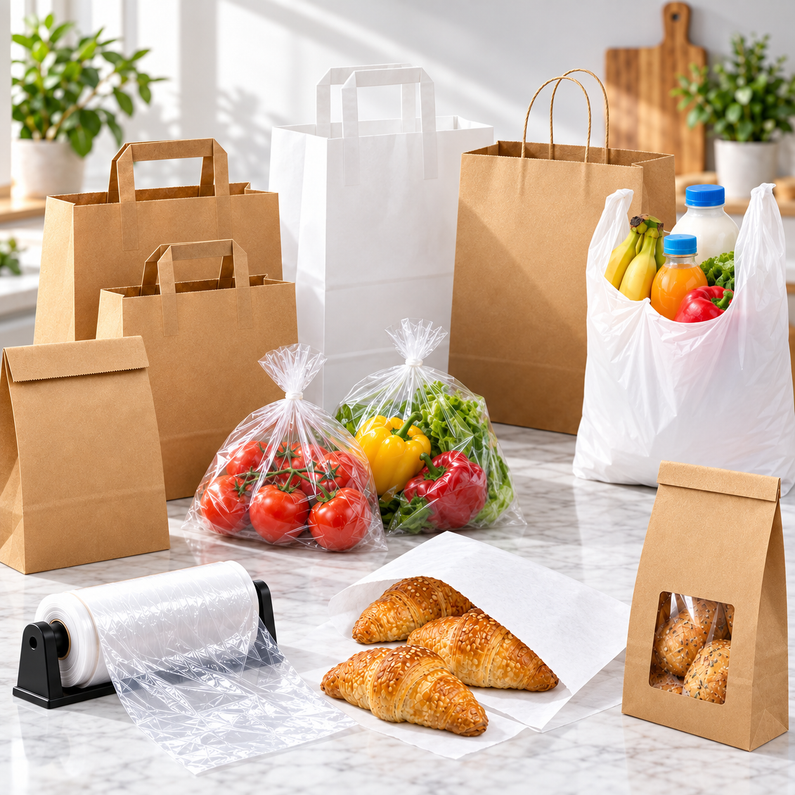
Takeaway & Food Bag Guide: Paper, Plastic & Polythene
How to Choose the Right Takeaway & Food Bags
Choosing the right takeaway or food bag is not simply a matter of deciding between paper and plastic. A bag used to carry a complete takeaway order performs a very different job from a bag used for bakery display, food preparation, vacuum packing or storing ingredients.
Restaurants, takeaways, bakeries, cafés, butchers, delis, grocery shops and caterers may therefore use several different bag types across the same business.
This guide explains the main differences between paper bags, plastic carrier bags, clear polythene bags and specialist food bags, helping you choose the most appropriate format for the food, product and application.
If you already know what you need, browse our complete takeaway and food bags range for paper, plastic, polythene and specialist bag options.
Quick Guide to Food & Takeaway Bag Types
| Bag Type | Common Uses | Best When |
|---|---|---|
| Paper Carrier & Grab Bags | Takeaway meals, bakery boxes, groceries and retail orders | You need an outer bag to carry a complete customer order |
| Paper Food Bags | Pastries, sandwiches, bread, snacks and bakery products | You are packing an individual food item |
| Film-Fronted Bags | Pastries, sandwiches, cookies and bakery display | Customers need to see the product |
| Plastic Carrier Bags | Takeaway, grocery and retail orders | You require a lightweight plastic carrying option |
| Clear Polythene Bags | Food preparation, bakery, produce, portioning and storage | Visibility and a wide choice of sizes or gauges are important |
| Self-Seal / Grip-Seal Bags | Ingredients, sweets, nuts and small food items | You want a bag that can be opened and resealed |
| Food Bags on Roll | Fruit, vegetables and loose produce | Fast dispensing is needed at a counter or produce display |
| Vacuum Bags | Meat, fish, cheese and food preparation | You are using compatible vacuum-sealing equipment |
| Foil-Lined Food Bags | Whole grilled chicken, burgers, kebabs and wraps | A specialist lined bag is required for suitable hot takeaway food |
| Butcher Packaging | Meat preparation, burger patties, counter packing and tray wrapping | You need specialist products for a butcher or meat counter |
1. Paper Carrier Bags for Takeaway & Retail Orders
Paper carrier bags are primarily designed to transport a customer's complete order. A takeaway may place several food containers, a bakery may pack cake or pastry boxes, and a retailer may use the same type of bag for multiple purchases.
The main styles include SOS bags, grab bags, flat-handle bags and twisted-handle paper carriers.
SOS & Grab Bags
SOS bags have a block-style base that allows the bag to stand open more easily while staff pack an order. Handle-free grab bags can also be useful where speed of packing is more important than providing a carrying handle.
Flat & Twisted Handle Bags
Handled paper carriers make it easier for customers to carry larger takeaway, grocery and retail orders. Different sizes are available, so businesses should match the dimensions and construction of the bag to the contents.
Browse our specialist paper carrier and grab bags for brown and white options in several formats.
2. Paper Food & Bakery Bags
Not every paper bag is a carrier bag. Smaller paper food bags are commonly used around individual bakery, snack and takeaway products.
Examples include brown kraft strung bags, white sulphite bags, greaseproof paper bags, baguette bags and French-stick bags.
Brown Kraft Paper Bags
Brown kraft bags provide a simple paper format for bakery, deli and food-to-go service. Strung versions can be particularly convenient at busy counters because individual bags can be removed quickly during service.
White Sulphite Bags
White sulphite bags offer an alternative presentation for suitable dry bakery, confectionery and food-to-go products.
Greaseproof Paper Bags
Where a product contains more oil or grease, a specialist greaseproof paper bag may be preferable to an ordinary paper bag. Always check the individual product specification for the intended food.
Baguette & French-Stick Bags
Baguettes and French sticks need a longer and narrower format than most standard bakery products. Specialist paper bags make it easier to package these products without using an unnecessarily oversized carrier bag.
You can compare these formats with the rest of our wholesale paper bag range .
3. Film-Fronted Bags for Bakery & Food Display
Sometimes the packaging needs to do more than simply contain the product. For bakeries, patisseries, cafés and delis, product visibility can be an important part of presentation.
Film-fronted bags combine a paper section with a transparent viewing area, allowing customers to see pastries, sandwiches, cookies, brownies and other suitable food-to-go products without opening the packaging.
They are particularly useful where several similar products are displayed together and customers need to see the difference between them.
Browse our film-fronted paper bags for white, brown and specialist baguette formats.
4. Plastic Carrier Bags
Plastic carrier bags remain useful for many takeaway, grocery and retail applications where a lightweight carrying bag is required.
They should not be confused with clear polythene food bags. A plastic carrier bag is primarily intended to carry an order, while a clear food bag is generally used for preparation, packing, portioning or storage.
Browse our plastic carrier bag range for available sizes and formats.
5. Clear Polythene Bags for Food Preparation & Storage
Clear polythene food bags are among the most versatile bags used in commercial kitchens, bakeries, delis and food-production environments.
Their transparent construction makes contents easy to identify, while the range of sizes and gauges allows businesses to select a bag appropriate for different food-preparation and packing requirements.
Common uses include:
- Ingredient portioning
- Food preparation before service
- Bread and bakery packing
- Fruit and vegetable packing
- Organising suitable chilled ingredients
- Deli and butcher preparation
- General food storage and stock organisation
Browse our clear polythene food bags for the available sizes and gauges.
Perforated vs Non-Perforated Polythene Bags
This is an important distinction.
Perforated bags contain small ventilation holes that allow airflow. They can be useful for selected bakery products, produce and other items where ventilation is desirable.
Non-perforated bags have a continuous plastic surface and are commonly used for general food preparation, ingredient portioning and packing.
The correct choice depends on the product, moisture level and storage conditions, so perforated bags should not automatically be considered better for every fresh food.
6. Self-Seal & Grip-Seal Bags
When a package needs to be opened and closed repeatedly, self-seal or grip-seal bags offer a convenient alternative to ordinary open-ended polythene bags.
They can be useful for suitable small food products and ingredients such as sweets, chocolates, nuts, dried ingredients and other portioned products. The transparent material also makes stock identification easier.
Browse our self-seal and grip-seal clear bags for different sizes.
7. Food Bags on Roll for Fruit & Vegetables
A shop selling loose fruit and vegetables has different requirements from a restaurant packing a takeaway meal.
Food bags on roll are designed for convenient dispensing at produce displays, greengrocers, supermarkets, market stalls, farm shops and other food-retail environments.
Staff or customers can take an individual bag when needed while the remaining bags stay organised on the roll.
See our food and produce bags on roll for current pack and size information.
8. Vacuum Bags for Commercial Food Packing
Vacuum bags and pouches are designed for use with compatible vacuum-sealing equipment. They are widely used by butchers, commercial kitchens, food processors and caterers for suitable meat, fish, cheese and prepared foods.
Machine compatibility is important. Smooth vacuum pouches are commonly used with chamber vacuum machines, while some external suction sealers require embossed or channelled bags.
It is also important not to assume that every vacuum bag is suitable for freezing, boiling or sous-vide cooking. Always check the individual pouch specification where temperature performance is important.
Explore our vacuum bags and food vacuum pouches .
9. Foil-Lined Bags for Grilled Chicken & Hot Takeaway Food
Foil-lined food bags combine a paper outer with an aluminium foil lining and are used for suitable hot takeaway foods.
One particularly important application is whole grilled or rotisserie chicken. Larger foil-lined bags can also be used for suitable chicken portions, while other formats may suit burgers, kebabs, wraps, paninis, grilled sandwiches, naan and flatbreads.
Foil-lined bags are not the same as rigid aluminium containers. Foods that contain large quantities of liquid or require structural support may be better suited to a tray or container.
Browse our specialist foil-lined food bags .
10. Butcher Bags & Meat-Counter Packaging
Butchers and meat counters often need more than one type of bag or wrapping product, which is why specialist butcher packaging is best considered as a complete system.
Depending on the task, this can include:
- Butcher counter bags for customer portions
- Victory high-tensile food bags for larger food-packing requirements
- Clear burger discs for separating burger patties
- Meat protective paper for wrapping and separating portions
- PVC meat-wrap film for trays and compatible wrapping equipment
- Replacement hot wires for tray wrappers
Vacuum bags and clear polythene bags may also be used elsewhere in the same butchery operation, depending on how the food is being prepared and packed.
See our butcher packaging and meat counter supplies for the specialist range.
Which Bag Should a Bakery Use?
A bakery will often need several different bags rather than one universal option.
- Strung paper bags can suit pastries, cookies and other counter products.
- Greaseproof bags are useful for suitable foods with more oil or grease.
- Film-fronted bags allow customers to see products on display.
- Perforated polythene bags may suit selected bread or bakery applications where ventilation is required.
- Baguette and French-stick bags provide a better shape for long bread products.
- Paper carrier bags can hold multiple purchases or bakery boxes when the customer leaves the shop.
Which Bags Should a Takeaway Use?
For most takeaway businesses, it helps to separate primary food packaging from the outer carrying bag.
For example, a burger might first be placed in suitable food packaging, while the finished order is then carried in an SOS or handled paper bag. A grilled chicken shop may use a foil-lined bag for the chicken before placing the complete order into a larger carrier.
Choose the outer bag according to the weight and dimensions of the complete order rather than the size of an individual menu item.
Which Bags Should a Commercial Kitchen Use?
Commercial kitchens typically need bags for preparation and storage rather than only takeaway transport.
Clear polythene bags can support portioning and ingredient organisation, grip-seal bags can be convenient for smaller items, and vacuum pouches may be used where compatible vacuum-sealing equipment is part of the operation.
The intended food, temperature and storage conditions should always determine the final choice.
Paper, Plastic or Polythene: Which Is Best?
There is no single bag material that is best for every application. The right choice depends on what the bag needs to do.
- Choose paper for many takeaway carriers, bakery bags, food bags and presentation-focused applications.
- Choose clear polythene where visibility, preparation, portioning or a choice of bag sizes and gauges is important.
- Choose plastic carrier bags where a lightweight plastic carrying format suits the order.
- Choose specialist bags when the application requires vacuum packing, a clear display window, a foil lining, resealable closure or another specific feature.
Rather than choosing solely by material, start with the food or product, bag function, size, weight, temperature and storage requirements.
What About Recycling & Disposal?
Packaging construction matters when considering disposal. A clean, uncoated paper bag may be accepted by some paper recycling services, while film-fronted or foil-lined bags contain more than one material and may require different handling.
Polythene recycling availability also varies between local authorities and commercial waste providers. Food contamination can affect whether a material is accepted.
For this reason, avoid assuming that every paper or plastic bag can be recycled in the same way. Check the individual product construction and the guidance provided by your local authority or commercial waste contractor.
How to Choose the Right Bag: 6 Questions to Ask
- Is the bag carrying a complete order or packaging an individual food item? This immediately separates carrier bags from most food bags.
- Does the customer need to see the product? If yes, clear polythene or film-fronted packaging may be useful.
- Is the food oily, greasy or very hot? Check whether a greaseproof, foil-lined or alternative food container is more suitable.
- Does the product need airflow? Selected bakery and produce items may benefit from perforated packaging.
- Does the bag need to reseal or work with machinery? Grip-seal and vacuum bags serve very different specialist purposes.
- What size and strength do you actually need? Avoid choosing a bag only by material. Dimensions, gauge and product weight can be equally important.
Buy Takeaway & Food Bags from Supply Express
Supply Express supplies bags in commercial quantities for restaurants, takeaways, bakeries, cafés, delis, butchers, caterers, grocery shops and retailers.
Our range covers everything from paper carriers and bakery bags to clear polythene, grip-seal, vacuum, foil-lined and specialist food-packaging bags.
Browse the complete takeaway and food bags range to compare the different options.
Free UK Mainland delivery is available on qualifying orders over £100 excluding VAT. Eligible orders placed before 15:00 can qualify for next working day delivery. Delivery restrictions, postcode exclusions, weekends and bank holidays may apply.
Frequently Asked Questions
What is the difference between a food bag and a carrier bag?
A food bag is generally used to pack an individual food item or ingredient, while a carrier bag is used to transport a complete takeaway, grocery or retail order containing one or more packaged items.
Which bags are best for takeaway food?
It depends on the food and how it is packed. Paper or plastic carrier bags can be used for complete orders, while individual foods may require paper food bags, greaseproof bags, foil-lined bags, containers or other specialist packaging.
Which bags are suitable for bakeries?
Bakeries may use kraft or sulphite paper bags, greaseproof bags, film-fronted display bags, perforated polythene bags, baguette bags and paper carriers depending on the product and purpose.
What is the difference between perforated and non-perforated polythene bags?
Perforated bags have small ventilation holes that allow airflow, while non-perforated bags have a continuous plastic surface. The best option depends on the food and required storage conditions.
Are grip-seal bags the same as vacuum bags?
No. Grip-seal bags use a press-together closure that can normally be opened and resealed. Vacuum bags are designed to be used with compatible vacuum-sealing equipment to remove air from around the food.
What bags are used for whole grilled chicken?
Larger foil-lined food bags are commonly used for suitable whole grilled or rotisserie chickens. Always choose the correct size and check the individual product specification for the intended food and temperature.
What bags do butchers use?
Butchers may use counter bags, high-tensile food bags, vacuum pouches, clear polythene bags and other specialist packaging. Burger discs, protective paper and PVC meat-wrap film may also form part of the same meat-preparation and counter-packaging operation.
Are all paper and plastic food bags recyclable?
No. Recycling depends on the material, construction, coatings, food contamination and the facilities available locally. Mixed-material bags such as film-fronted or foil-lined products may require different handling from plain paper bags.
Recent Posts
-
Takeaway & Food Bag Guide: Paper, Plastic & Polythene
How to Choose the Right Takeaway & Food Bags Choosing the right takeaway or food bag is not simply a … -
Catering Platter & Disposable Plate Size Guide
Plastic, Pulp & Aluminium Platters for Buffets, Bakeries & Catering Choosing the right catering plat …24th Sep 2026 -
Pizza Box Size Guide for Takeaway & Delivery
7, 9, 10, 12, 13 & 14 Inch Pizza Boxes Explained Choosing the right pizza box size is about more tha …23rd Sep 2026